

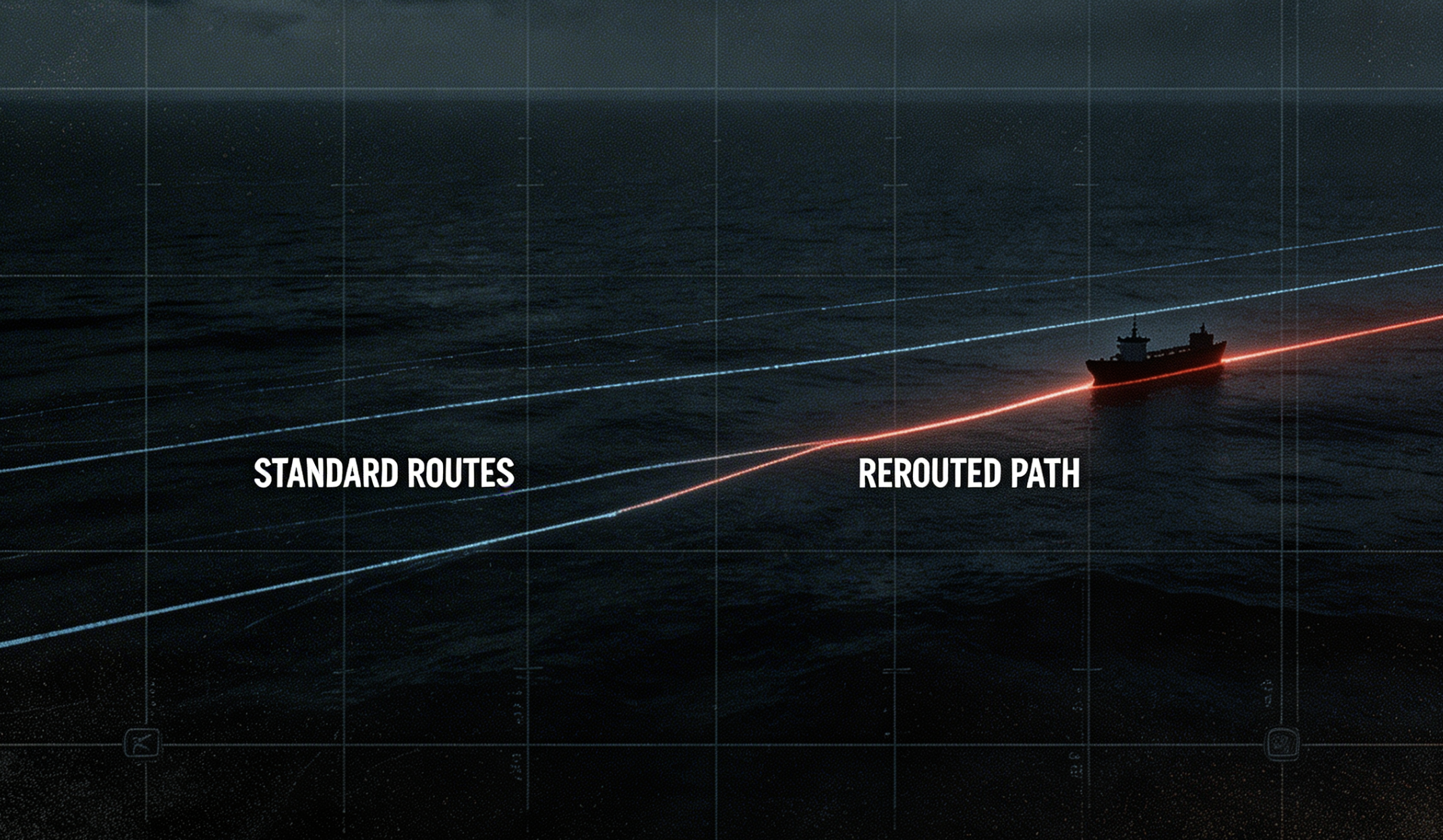
The story everyone is watching has a name and a map.
What is harder to see—at first—is how organizations adjust while the map still looks familiar.
They do not always announce those adjustments. They show up as small edits to how things move, how fast, and under what assumptions. The public narrative can stay fixed on a single choke point while the system quietly tests alternatives, builds slack where it can, or simply pays more to keep the same appearance of normal.
That gap between narrative and ledger is the interesting part.
Energy is the obvious layer when the conversation turns toward the Gulf. The obvious question is whether barrels stop. The subtler question is whether they start behaving differently before anyone uses the word disruption.
Premiums can widen without a dramatic headline. Certain grades become easier or harder to place. Traders and charterers talk about insurance and routing as administrative detail until those details become the whole conversation. None of that requires a closure to be instructive. It only requires people with money on the line to start pricing in a wider range of outcomes than they did last month.
The same logic applies further down the chain.
Recommended reading
Why Energy Prices Spike Before Anyone Warns You
The early signals most people miss before energy costs jump.
Manufacturing does not only run on crude. It runs on molecules and materials that rarely make evening broadcasts. When one region’s supply of something specialized becomes less predictable, the first sign is often not an empty shelf. It is a longer quote time, a substitution pushed without fanfare, or a contract that suddenly prefers a different origin even when the old one is “still available.”
Helium and other constrained inputs have lived in that category for years. They are easy to ignore until a single plant hiccups or a logistics path lengthens. Then the system does what it always does: it routes around, blends, delays non-critical uses, and tries not to alarm anyone who does not need to know yet.
That is not a prediction of failure. It is a description of how pressure expresses itself when people still want to sound calm.
Freight and timing tell a parallel story.
A delay does not have to become a disruption to matter. It only has to stop being rare. When “a few extra days” becomes the new default on certain lanes, planners respond—more buffer, earlier orders, different ports, more air where sea used to suffice. Each choice has a cost. Those costs accumulate in places consumers rarely watch: inventory lines, working capital, the willingness to commit to long-dated plans.
Regional markets can diverge without a global crisis in the classical sense.
What is expensive or scarce in one basin may still look ordinary in another—for a while. That wedge does not always close gently. It can pull investment, pull stock, and reshape who is willing to ship what to whom. The headline remains global; the experience is often local until it is not.
Pricing is another place where the signal hides in texture.
Spikes are easy to photograph. What is more common in the early phase is unevenness: the same product, different availability by channel; the same service, different fine print; the same sticker, slightly different pack or terms behind it. People feel something is off before they can cite a single cause. That feeling is easy to dismiss as mood. Sometimes it is mood. Sometimes it is the first pass of a shared adjustment.
None of this requires certainty about what happens next.
It only requires noticing that organizations—not commentators—are already behaving as if the range of plausible paths has widened. They hedge. They shorten commitments. They favor options that cost more today but preserve flexibility tomorrow.
The interesting work is not to declare where it ends.
It is to watch which small irregularities persist after the news cycle thins—delays that do not snap back, spreads that do not fully normalize, routes that stay altered because nobody wants to be the last one assuming last year’s calm.
This is usually where things start to move.
Recent updates
- Why "Normal" Is Becoming Harder To DefineThe baseline people rely on is shifting more than they realize.
- The Supply Signals Most People Miss CompletelyNot all supply disruptions look like empty shelves.
- Why Certain Price Changes Don't Show Up Where You ExpectSome of the most important pricing signals never appear in headline data.